
Hybrid work has opened new possibilities for flexibility, autonomy, and work-life balance. Yet it has also introduced a challenge that many organizations did not anticipate: staying connected in ways that feel authentic, supportive, and human. Video calls replace hallway conversations, chat messages replace tone and nuance, and asynchronous workflows replace the natural rhythm of shared physical spaces. While hybrid work offers real advantages, many teams quietly struggle with a sense of distance, misunderstanding, and fragmentation.
Gallup’s 2025 State of the Global Workplace Report highlights this reality, showing that exclusively remote employees report daily loneliness at 27 percent, compared with lower rates among on-site teams. Loneliness is not the only concern; misunderstanding rises as behavioral cues diminish. APA’s Work in America 2025 survey further reinforces this pattern, with workers reporting that unclear communication or sudden expectations significantly increase stress and reduce wellbeing. When interactions lack richness, people often fill in gaps with assumptions.
Social Dynamics provides leaders and teams with a practical way to navigate hybrid communication differences. By understanding natural interaction patterns, teams can recreate the connection, clarity, and cohesion that make work feel human even when people are not physically together.
Why Hybrid Work Makes Connection Harder
Teams working in hybrid environments experience both the benefits and the strain of physical distance. Without shared spaces, individuals lose access to the subtle interpersonal cues that help them accurately interpret and respond to one another. Small misunderstandings multiply. People become cautious about tone or worry that their messages are being misread. Team members who rely on relational interaction may feel disconnected, while those who prefer reflection may feel overwhelmed by digital noise.
These challenges are the result of teams carrying their natural patterns into environments where those patterns are harder to recognize. When behavioral differences aren’t named or understood, hybrid settings amplify them.
Some examples include:
- Quick messages feel abrupt without relational context.
- Pauses in virtual meetings feel longer and more ambiguous.
- Facial expressions and vocal tone become less reliable indicators of meaning.
- People interpret silence differently, not always correctly.
- Threaded digital communication makes pacing harder to interpret.
Without shared behavioral understanding, teams are left to guess at intention.
Natural Patterns Become More Visible and More Misinterpreted Online
Social Dynamics identifies four natural patterns of acting and interacting: Mover, Mapper, Involver, and Integrator. These patterns appear everywhere, but hybrid environments accentuate them because the usual buffering cues are absent.
The 4 Social Dynamics Styles
None of these reactions are problematic on their own. The issue arises when teammates misinterpret the behaviors.
The Hidden Cost of Misinterpreting Behavior in Hybrid Work
Misinterpretation is one of the most common and costly dynamics in hybrid settings. Without shared context, teams often make inaccurate assumptions:
- Slow response = disengagement
- Quick response = impatience
- Many questions = criticism
- Few questions = agreement
- Enthusiastic messages = loss of focus
- Brief messages = emotional detachment
These assumptions create avoidable tension and distance. Psychological safety decreases as people become cautious about expressing themselves. Misunderstandings multiply, and collaboration slows.
Research supports this. APA’s findings show that workers feel significantly more stress when expectations shift quickly or when communication lacks clarity. Hybrid work magnifies these conditions because communication feels more ambiguous. When stress rises, people revert to their natural pattern, which further increases behavioral contrast.
How Social Dynamics Restores Connection and Clarity in Hybrid Teams
Social Dynamics gives hybrid teams a behavioral framework that helps them interpret one another more accurately and communicate more intentionally. When people understand patterns, they no longer take behavior personally. They respond with awareness rather than assumption.
Social Dynamics Helps Teams Decode Behavior
Understanding interaction patterns helps teammates interpret messages more accurately. A delayed response from an Integrator becomes reflection, not withdrawal. A quick decision from a Mover becomes momentum, not disregard. A Mapper’s questions become clarifying, not challenging. An Involver’s energy becomes engagement, not noise.
This reduces emotional strain and miscommunication.
Supporting Predictable Communication Routines
Hybrid work feels more stable when communication is predictable. Social Dynamics helps teams establish patterns for:
- When decisions are made
- What level of detail is needed
- How much discussion is appropriate
- When reflection is necessary
- How questions are interpreted
Predictability increases trust and reduces stress.
Helping Leaders Tailor Support in Meaningful Ways
Gallup found that manager effectiveness strongly influences hybrid engagement, and workers who feel adequately supported report higher well-being and lower burnout. Social Dynamics gives leaders insight into what each pattern needs:
- Movers → timely direction and quick loops
- Mappers → structure and context
- Involvers → connection and interaction
- Integrators → clarity and time
Even small adjustments make hybrid communication feel more human. Programs such as EQ Accelerator help leaders apply these insights consistently.
Helping Teams Rebuild the Social Fabric Lost in Hybrid Work
Because Involvers and Movers often carry relational energy, Social Dynamics helps leaders intentionally create moments of connection that benefit the entire team. Mappers and Integrators also benefit from clear expectations and thoughtful transitions that ground them emotionally.
Hybrid work becomes less isolating and more cohesive.
Practical Ways to Use Social Dynamics to Improve Hybrid Connection
Teams can begin applying Social Dynamics in hybrid settings immediately. These practices help restore clarity, reduce fatigue, and strengthen connection.
Name the Purpose Before Communicating
Before sending a message or starting a meeting, state:
- “This is an update.”
- “This is for input.”
- “This is a decision.”
This prevents mismatched assumptions and reduces misinterpretation.
Clarify Pacing Expectations
For example:
- “Respond when you’ve had time to reflect.”
- “We need a quick answer.”
- “Take the afternoon to think about this and reply tomorrow.”
These signals prevent emotional misreading.
Balance Synchronous and Asynchronous Collaboration
- Movers and Involvers do well in real-time discussion.
- Mappers and Integrators benefit from advance materials.
Sharing information ahead of time supports all patterns.
Create Micro-Connections
Short relational touchpoints restore humanity in hybrid work. Examples:
- Brief check-in questions
- Small gratitude moments
- Acknowledgment of contributions
These matter for every pattern.
Normalize Pattern-Based Questions
Questions like:
- “Would you like more detail or less?”
- “Do you want time to think or should we discuss now?”
- “How much structure helps here?”
These reduce friction and honor natural tendencies.
Encourage Transparency About Needs
People can share:
- “I move quickly. Tell me if you need more time.”
- “I process internally, give me a moment.”
- “I like to explore ideas, stop me if we need to narrow.”
- “I need detail before committing.”
These statements strengthen trust and connection. Over time, teams strengthen collaboration skills supported by Developing People Skills and Type Dynamics.
Hybrid Work Feels Human When People Understand Each Other
Hybrid work does not need to feel distant or disconnected. It becomes more human when teams understand the natural behavioral patterns that shape how individuals communicate, collaborate, and respond to uncertainty. Social Dynamics brings these patterns into the open, giving teams a shared language for interpreting behavior and supporting one another more intentionally.
When teams understand each other better, communication becomes clearer. Misunderstanding decreases, stress softens, and hybrid work begins to feel less like a technological challenge.
With Social Dynamics, teams can stay aligned, connected, and confident, no matter where they work.
FREE DOWNLOAD
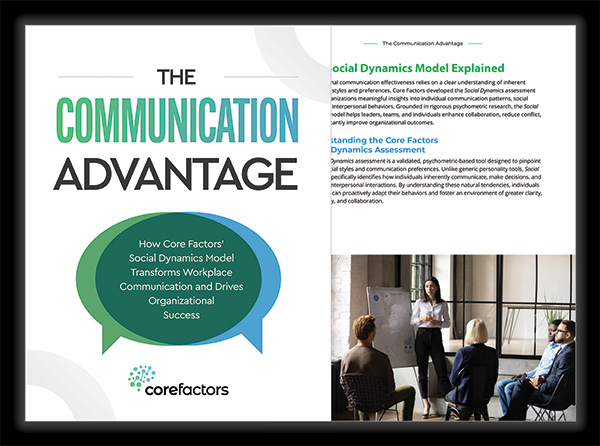
The Communication Advantage: How Core Factors' Social Dynamics Model Transforms Workplace Communication and Drives Organizational Success
Podcast: Play in new window | Download
Recommended Reading
How to Connect and Collaborate with Anyone
This booklet reveals the hidden patterns that shape how people communicate, make decisions, contribute to teams, and respond to conflict. Discover how to turn differences into connection, and connection into productive collaboration.
View the Booklet