
Leaders have to understand their internal emotional patterns and express themselves in ways that support clarity, trust, and collaboration. In many organizations, those two demands are trained separately. Emotional intelligence programs focus on awareness and regulation. Communication and interaction programs focus on behavior. Leaders learn what to understand about themselves and how to interact with others, but not how the two influence each other in real time.
Core Factors brings the two together through complementary models. EQ Accelerator describes a person’s emotional patterns and helps them build emotional awareness, stability, and self-regulation. Social Dynamics describes the innate style of acting and interacting that emerges in meaningful situations at work.
Used together, these models help leaders understand both the internal emotional experience that fuels their reactions and the external pattern others see when they interact, collaborate, or perform under pressure. That combination gives practitioners, coaches, and organizations a more complete and practical way to strengthen leadership impact, team health, and everyday collaboration.
EQ Accelerator: Understanding Internal Emotional Patterns
EQ Accelerator focuses on the emotional dimension of human effectiveness, the inner experience that shapes how people feel, respond, and regulate themselves. Emotional intelligence comes from recognizing internal patterns, understanding personal triggers, and responding intentionally rather than automatically.
EQ Accelerator helps individuals:
- Build emotional self-awareness
- Identify internal cues of stress, tension, or imbalance
- Strengthen self-regulation and composure
- Expand empathy and attunement
- Recognize how emotional states influence perception and decision-making
- Respond more effectively to pressure, change, or challenge
It answers one question: what emotional patterns influence how I experience the moment?
That internal awareness is essential, and it does not automatically translate into effective interaction with others. A leader may understand that they are feeling stressed yet still respond in ways others read as frustration. A person may know they value connection but struggle to express it skillfully during conflict. EQ describes the inner experience rather than the outward behavior.
Social Dynamics adds that missing layer.
Social Dynamics: Understanding External Interaction Styles
Social Dynamics addresses the behavioral dimension: the natural style individuals use when interacting with others in meaningful, real-world situations. These styles emerge consistently across collaboration, decision-making, influence, and conflict.
Social Dynamics identifies four styles.
The 4 Social Dynamics Styles
These styles are innate and repeatable, surfacing especially in moments that matter: when stakes are high, time is short, relationships are on the line, or outcomes carry consequences.
Social Dynamics answers a different question: how do I naturally act with others when results or relationships are meaningful?
Social Dynamics describes behavior without diagnosing emotion. A person may feel calm internally yet behave quickly because that is their natural style. Another may feel deep emotion yet express themselves through quiet reflection. When leaders understand their style, they gain clarity about how others experience them and why misunderstandings arise even when intentions are good.
Why Emotional Intelligence and Interaction Styles Need Each Other
The two models describe different dimensions of human functioning, and they become considerably more useful when applied together. Leaders benefit when they can connect their internal emotional experience with their external behavioral expression.
Internal States Influence External Behavior, But Not Predictably
A leader may feel calm but act quickly because of a natural Mover style. Another may feel stressed but appear composed because of a natural Mapper style. Without both models, people misinterpret either the emotion or the behavior.
EQ Explains Why Leaders React; Social Dynamics Helps Them Adjust How
Leaders can regulate their internal emotional state through EQ Accelerator while flexing their interpersonal behavior through Social Dynamics to meet the needs of the moment.
Understanding Both Reduces Misinterpretation in Teams
Teams routinely misread behavior:
- A fast decision is read as carelessness rather than clarity.
- Enthusiastic engagement is read as overreaction.
- A reflective pause is read as hesitation rather than thoughtfulness.
- A cautious approach is read as negativity.
EQ Accelerator helps leaders understand emotional patterns. Social Dynamics helps teams interpret behavior accurately.
Development Becomes More Precise and Actionable
EQ explains what is happening inside. Social Dynamics explains what others experience. Together they provide a roadmap for authentic adaptation.
How EQ Accelerator Strengthens Social Dynamics
EQ Accelerator improves a leader’s ability to use their style intentionally rather than automatically.
Emotional Awareness Reduces Reactive Overuse of a Style
A Mover under stress may intensify pressure on the team; emotional awareness helps them recognize and modulate that. An Involver under stress may seek reassurance; the same awareness gives them self-calming tactics to draw on instead.
Emotional Regulation Allows Leaders to Flex Behavior
When leaders are not emotionally overwhelmed, they can adapt pacing, prompting, tone, and decision approach to support others.
Empathy Improves How Leaders Interpret Other Styles
EQ Accelerator builds emotional understanding. Social Dynamics adds behavioral understanding. Together they prevent misattributed intent.
EQ Makes Behavioral Adjustments Feel Authentic
Adaptation becomes an expression of awareness rather than a technique applied from the outside.
How Social Dynamics Strengthens EQ Accelerator
Social Dynamics deepens emotional intelligence by clarifying the link between internal feeling and external action.
Leaders Can Distinguish Emotional Triggers From Behavioral Tendencies
A fast-moving style is not always emotional overwhelm. A quiet style is not always emotional withdrawal. Separating the two sharpens emotional insight.
Leaders Understand Why Others React to Their Behavior
A Mover’s urgency may unintentionally trigger stress in an Integrator. An Integrator’s careful questioning may trigger impatience in a Mover. Recognizing the styles at work reduces emotional friction.
Social Dynamics Structures Emotionally Charged Feedback
EQ Accelerator helps regulate emotional tone. Social Dynamics helps structure the message behaviorally.
Leaders Can Clarify Their Behavior Before Emotion Escalates
Statements like “I move quickly, I’m not frustrated” or “I need time to reflect, it’s not disagreement” reduce misinterpretation and emotional strain.
How Practitioners Use Both Models Together
Practitioners who combine EQ Accelerator and Social Dynamics gain a fuller toolkit for supporting leaders and teams.
Leadership Coaching
Coaches can distinguish whether a challenge is rooted in emotional triggers, interaction styles, or both. That distinction sharpens where the coaching should focus.
Team Development and Psychological Safety
Teams come to understand emotional needs alongside behavioral contributions. This reduces judgment and increases trust.
Conflict Navigation
EQ Accelerator helps leaders manage their own emotions. Social Dynamics helps them see the behavioral misinterpretations feeding the conflict.
Change Leadership
Leaders use EQ to support emotional resilience and Social Dynamics to manage behavioral responses to uncertainty.
Communication and Feedback Training
EQ Accelerator strengthens empathy and emotional tone. Social Dynamics clarifies pacing, prompting, and behavioral adjustments. Together they turn difficult conversations into constructive ones.
When Emotional Insight Meets Behavioral Clarity
Emotional intelligence helps people understand themselves. Social Dynamics helps people understand each other. Together, they allow leaders to bring more intention, compassion, and effectiveness to their work.
EQ Accelerator strengthens the internal foundation of awareness, regulation, empathy, and emotional clarity. Social Dynamics strengthens external expression through behavioral awareness, adaptability, and interpersonal effectiveness.
When leaders understand both dimensions, they can show up with confidence and authenticity in complex, high-pressure environments. They communicate with clarity, navigate stress with composure, and collaborate in ways that strengthen team trust and performance. Human complexity is both a challenge and an asset, and combining these two models helps organizations develop leaders who are emotionally intelligent and behaviorally effective.
FREE DOWNLOAD
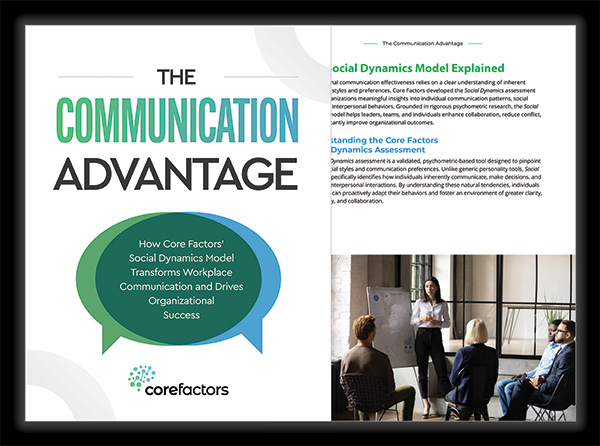
The Communication Advantage: How Core Factors' Social Dynamics Model Transforms Workplace Communication and Drives Organizational Success
Recommended Reading

How to Connect and Collaborate with Anyone
This booklet reveals the hidden patterns that shape how people communicate, make decisions, contribute to teams, and respond to conflict. Discover how to turn differences into connection, and connection into productive collaboration.
View the Booklet