
Every day, people bring two forces into their work: what internally motivates them, and how they naturally act with others when something meaningful is at stake.
These forces are distinct but deeply connected. Motivation shapes what individuals pursue and why certain work feels energizing or draining. Interaction styles shape how people collaborate, communicate, make decisions, and respond to pressure. When leaders and practitioners understand both, they gain a clearer view of the whole person: what drives them internally and how they move through the world externally.
Temperament Dynamics and Social Dynamics each describe one of these dimensions. Temperament Dynamics focuses on an individual’s deep motivations. Social Dynamics focuses on their style of interaction with others. Each model stands on its own, yet when used together they help practitioners understand and support people in a more complete, human-centered way.
Temperament Dynamics: The Motivational Backbone of Human Behavior
Temperament Dynamics identifies the motivational patterns that shape what individuals value and how they direct their energy. These are the deeper internal drivers that give meaning and purpose to a person’s work.
Temperament Dynamics expresses motivation through four patterns.
The 4 Temperament Dynamics Patterns
These patterns describe what energizes people: what they gravitate toward naturally, what helps them persist through difficulty, what makes work feel significant, and what creates engagement or strain.
Temperament Dynamics answers one question: what internally motivates this person, and what conditions help them thrive?
Knowing someone’s motivation does not tell you how they interact with others in real time. That is the role of Social Dynamics.
Social Dynamics: How People Act and Interact When Results Matter
Temperament explains the internal why. Social Dynamics describes the how: the external behavioral style individuals use when collaborating, leading, influencing, or navigating conflict. It focuses on how energy expresses itself socially in the Relational dimension of human behavior.
Social Dynamics identifies four interaction styles.
The 4 Social Dynamics Styles
These styles are visible in how people communicate, how they approach decisions, how they respond under pressure, how they move toward a result, and how they collaborate.
Social Dynamics answers a different question: how does this person naturally act with others when it matters to them?
That outward expression is distinct from the person’s internal motivational drive. Temperament Dynamics covers what matters most. Social Dynamics covers how a person moves through the world to get there. Because the two dimensions serve different purposes, conflating them reduces clarity. Keeping them separate preserves accuracy and strengthens insight.
How Temperament and Social Dynamics Work Together Without Overlap
When practitioners or leaders integrate the two models, they gain the ability to understand people across two dimensions.
The internal drive (Temperament). What energizes this person? What do they value? What helps them stay motivated?
The external expression (Social Dynamics). How do they collaborate? How do they behave during decision-making? How do they interact under pressure?
Together, these lenses allow practitioners to answer questions that no single model fully addresses:
- Why does this person choose these approaches?
- Why does this person feel strained in certain environments?
- Why do their outward behaviors sometimes get misinterpreted?
- How can others support them more effectively?
- What does this person need to feel both motivated and understood?
Real-World Examples of How Motivation Meets Interaction
These simplified scenarios show how the two dimensions combine to create the lived experience of a team member or leader.
A Decisive Empathic Blue
Temperament: Empathic Blue, motivated by harmony, values, and authenticity. Social Dynamics: Mover, direct and action-oriented.
This person may surprise others. Their decisions are rooted in care, values, and impact, but expressed rapidly and decisively. When misunderstood, others think they are pushing. When understood, others see someone acting boldly in service of meaning and other people’s well-being.
A Thoughtful Adaptable Orange
Temperament: Adaptable Orange, motivated by freedom and flexibility. Social Dynamics: Integrator, reflective and detail-focused.
This person values adaptability and responsiveness, yet behaves externally with careful consideration. The motivation behind freedom shows up as wanting the clarity needed to navigate unpredictability wisely.
An Idea-Generating Anchoring Gold
Temperament: Anchoring Gold, motivated by stability and clear roles. Social Dynamics: Involver, engaging and collaborative.
This combination produces a stabilizing presence who generates energy through group participation. They care about practical action and responsibility, and they express it through involvement, connection, and shared engagement.
A Structured Inquisitive Green
Temperament: Inquisitive Green, motivated by logic, depth, and mastery. Social Dynamics: Mapper, structured and sequenced.
This pair creates someone who seeks conceptual precision internally and translates it into systematic, practical clarity for others.
How Practitioners Use Both Models Together
Temperament Dynamics and Social Dynamics can be used independently, and many practitioners use one alone with great success. When the work requires deeper insight, integrating the two becomes especially valuable.
Leadership Coaching
Coaches can identify whether a challenge stems from a motivational misfit, an unhelpful interpersonal behavior, or a combination of both. That distinction leads to clearer, more personalized development plans.
Team Effectiveness
Teams come to understand why people care about different things and why they behave differently in collaboration. This reduces misinterpretation and increases trust.
Navigating Conflict
Conflict often emerges when someone’s motivational needs feel threatened or their behavioral expression is misunderstood. Using both models helps leaders address both sources constructively rather than treating every disagreement as the same problem.
Change and Stress Support
Under stress, the relational style shows how a person will react and the motivational pattern shows why the situation feels challenging. Together they inform how leaders communicate and support individuals during uncertainty.
Career Alignment
Roles that align with both internal motivation and natural interaction style produce more sustainable engagement than roles that satisfy only one.
Supporting People as Whole Humans
Temperament Dynamics helps us understand a person’s internal motivational landscape. Social Dynamics helps us understand their external interaction style. Each model tells a different part of the story. Together, they help leaders and practitioners see people more fully and support them more effectively.
This integration honors individuality, strengthens trust, and helps teams collaborate with less friction and more humanity. When people feel both energized and understood, sustainable performance follows.
FREE DOWNLOAD
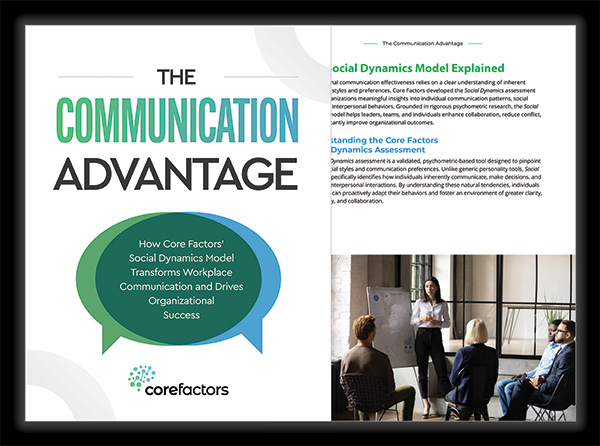
The Communication Advantage: How Core Factors' Social Dynamics Model Transforms Workplace Communication and Drives Organizational Success
Recommended Reading
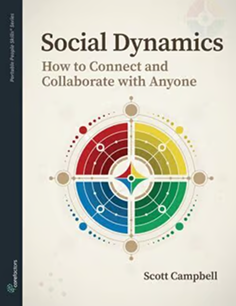
How to Connect and Collaborate with Anyone
This booklet reveals the hidden patterns that shape how people communicate, make decisions, contribute to teams, and respond to conflict. Discover how to turn differences into connection, and connection into productive collaboration.
View the Booklet